
Cardiac shock wave therapy (CSWT): What do current studies show about exercise capacity, symptoms, and quality of life?
Highly relevant new study data classify what patients with refractory angina pectoris can expect from CSWT
For many people with chronic coronary heart disease (CHD), the path to treatment is currently clearly defined: medication, catheter procedures, bypass surgery. However, there is a group of patients for whom these options have been exhausted – people with so-called refractory angina pectoris. They continue to suffer from debilitating chest pain, limited exercise capacity, and significant restrictions on their quality of life, even though all guideline-based treatments have been exhausted.
It is precisely for this group of patients that cardiac shock wave therapy (CSWT) has been the focus of scientific research for several years. A new clinical study now provides further important data on the changes patients can experience with this non-invasive therapy, which we at Schlosspraxen Meyer are the first specialist practice in Germany to use.
Cardiac shock wave therapy (CSWT) – a different therapeutic approach
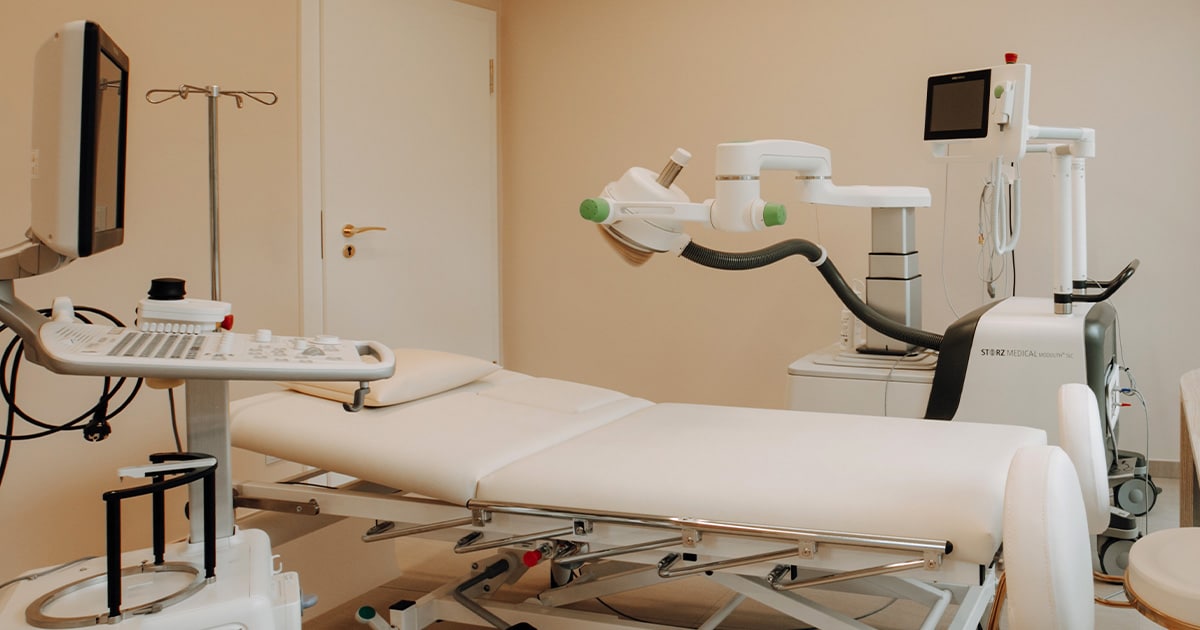
Cardiac shock wave therapy (CSWT) follows a different medical principle than classic interventional procedures. Instead of mechanically opening or bypassing vessels, it aims to stimulate the body’s own regeneration and adaptation processes in the heart muscle.
The treatment is performed on an outpatient basis, without anesthesia and without surgical intervention. Low-energy shock waves are applied specifically to areas of the heart muscle with poor blood flow. Research suggests that these mechanical impulses can stimulate microcirculation, neovascularization, and endothelial function.
However, what this means for patients in concrete terms cannot be deduced from theoretical models alone—clinical data is crucial.
New clinical study: Efficacy and safety of CSWT in refractory angina pectoris
The current study, published in the journal “Vascular Health and Risk Management,” investigated the efficacy and safety of cardiac shock wave therapy, or CSWT for short, in patients with ischemic heart disease and refractory angina pectoris.
The study included 65 patients who were no longer suitable for further catheter-based or surgical revascularization procedures. The participants were followed up over a period of six months. Both subjective symptoms and objective clinical and imaging parameters were examined.
Study shows significant changes in angina symptoms and medication requirements
A key finding of the study concerns the frequency of angina attacks. Before starting CSWT, patients reported an average of more than six angina episodes per week. After completing treatment, this number dropped to less than one episode per week.
At the same time, the need for short-acting nitrates also decreased significantly. These medications are often used to relieve acute chest pain. The significant decrease in nitrate consumption indicates that many patients experienced less severe symptoms in their daily lives.
The clinical classification of the symptoms also improved: both the CCS classification of angina pectoris and the NYHA classification of exercise capacity showed significant shifts toward milder stages.
Greater resilience in everyday life – clinically relevant results on everyday performance
In addition to subjective symptoms, the study also objectively recorded physical performance. In the 6-minute walk test, an established measure of everyday resilience, patients covered an average of more than 100 meters more after CSWT.
This improvement is clinically relevant because it reflects not only laboratory values or imaging, but actual physical performance in everyday life.
CSWT therapy in the study: improvements in heart function and blood flow
The imaging results of the study are particularly revealing. Echocardiography showed improvements in left ventricular function, measured in terms of ejection fraction and global longitudinal strain (GLS), among other parameters. All of these parameters provide information about the performance of the heart muscle.
In addition, nuclear medicine examinations (SPECT) were performed to assess myocardial blood flow. These showed a significant reduction in perfusion defects, especially in areas that were previously poorly perfused. These objective measurements support the assumption that CSWT therapy can have a positive effect on blood flow in the heart muscle.
Safety of cardiac shock wave therapy: No serious side effects observed
A key aspect of any new therapy is patient safety. In this study, as in other studies before it and in our everyday practice, no relevant side effects occurred. No cardiac arrhythmias, treatment-related complications, or deaths were reported. Laboratory markers for heart damage also remained normal.
New CSWT study: How can these results be interpreted?
It is important to interpret the results objectively: The study is a single-arm clinical trial without a control group. The results show clear improvements, but do not allow any conclusions to be drawn in terms of proof of efficacy according to strict pharmaceutical criteria.
At the same time, the data are consistent with existing studies. International reviews, meta-analyses, and current guidelines—including those of the European Society of Cardiology—list CSWT as a potential treatment option for refractory angina pectoris when established procedures have been exhausted. The study thus confirms the previously known favorable safety profile of CSWT, especially in comparison to invasive procedures.
When study results become tangible in everyday life: a patient reports
The case study of a patient who spoke in a European study also shows how the effects described in studies can feel in everyday life. The patient, who had suffered from coronary heart disease and severe angina pectoris for many years, reported severely limited exercise capacity before starting CSWT. Even short walks led to chest pain, regular nitrate doses were part of everyday life, and physical activity was hardly possible.
During the course of CSWT treatment, the patient described gradual changes. The frequency of angina attacks decreased, his exercise capacity in everyday life improved, and simple activities such as walking became possible again. The need for acute medication also decreased.
We expressly emphasize that this is an individual experience. However, such observations are consistent with the results of recent studies, which also report a reduction in angina symptoms, improved exercise capacity, and good tolerability of CSWT. It is precisely this combination of clinical research and medical experience that helps to responsibly classify new therapeutic approaches.
Classification of the new study results: What does this mean for our patients?
The study shows that patients undergoing cardiac shock wave therapy (CSWT) can experience measurable improvements in their symptoms, exercise capacity, and heart function.
However, it also points out that CSWT is not yet a substitute for established therapies, but rather a complementary option for selected patients.
Whether CSWT is appropriate in individual cases always depends on the individual’s initial situation, existing heart disease, and careful medical consideration.
Conclusion: CSWT is a gentle therapy with a growing scientific basis
The new study provides important evidence that cardiac shock wave therapy (CSWT) can contribute to clinically relevant improvements in difficult-to-treat heart patients – while also being very well tolerated.
For many patients for whom conventional therapies have reached their limits, this opens up an additional, non-invasive treatment approach that is increasingly being investigated scientifically.
You can find the new study in our “CSWT-Studies” section:
or here via direct link: